Dimanche 18 Mars
Réappropriations et empowerment
Des féminismes au Queer
Les cinémas féministes et Queer ont été – et sont – le lieu d’une réappropriation de la subjectivité des sujets politiques, dans un mouvement toujours en chantier de décolonisation des imaginaires. Le cinéma féministe a ainsi révélé sa puissance en se faisant le lieu d’une récupération de la parole qui accompagnait à la fois les processus de prise de conscience intimes et les mouvements protestataires. Comment survient cette parole ? La production artistique dans ce geste de réappropriation par les minorités est-elle bouleversée dans ses formes mêmes ?
Qu’en est-il pour le cinéma Queer ? Nous verrons au travers d’un panorama des pionnières de la vidéo féministe (Nil Yalter, Barbara Hammer, Klonaris/Thomadaki) jusqu’aux artistes Queer d’aujourd’hui (Sothean Nhieim, Del La Grace Volcano, Oreet Ashery, Nexus, Gina Lamb) comment se mobilisent différents processus de récupération de la parole, depuis la performance dans les ballrooms ou le Camp comme recitations insolentes ou rêveuses (Sothean Nhieim ou Gina Lamb), à une autre pratique des savoirs situés, de l’expertise (GAT), dans le cadre précis d’une politique des savoirs et des représentations, d’une articulation entre savoir et pouvoir, en passant par les alter egos (Oreet Ashery), ou une forme de mélancolique reconstitution de l’imaginaire d’un espace autonome, d’un squat queer (Ruins), réinventant d’autres productions de l’imaginaire, avec d’autres référents, d’autres réseaux symboliques.
18h30
Féminisme et fictions collectives
Féminisme et fictions collectives
Séance présentée par Hélène Fleckinger (Historienne du Cinéma, Université de Paris 1 Panthéon-Sorbonne, spécialiste du cinéma féministe des années 70)
Regarde, elle a les yeux grands ouverts
de Yann Le Masson
(France, 1980, BetaSP, 62’)
de Yann Le Masson
(France, 1980, BetaSP, 62’)
 Regarde, elle a les yeux grands ouverts, ne se limite pas à un documentaire autour du procès d’Aix-en-Provence de 1976 contre le MLAC (Mouvement pour la Libération de l’Avortement et de l’Accouchement), pour exercice illégal de la médecine et tentative d’avortement sur mineur, alors que la loi Veil sur l’avortement était passée en 1974. Il est aussi une très douce et sensible observation et reconstitution des principes autogestionnaires du MLAC, des méthodes alternatives d’accouchement, pratique devenue collective, repoussant les limites du corps décent ou indécent et le contrôle de l’institution médicale, pour mieux inventer un autre rapport au corps et une possibilité chorale de lutter. Issu du travail de cinq collectifs différents, le fascinant et magnifique documentaire / fiction de Yann Le Masson, est le lieu d’un autre mode de production des images, celui d’une fabrique collective, alors que chacune des protagonistes rejouent leur propre rôle. Un trouble se déploie dans la constitution communautaire d’un corps autrement médicalisé, dans la douceur amoureuse des manifestations, la précision confiante de dire son rapport à l’enfantement ou au refus, une autre gestion du corps nu. KQ & AI «Il s’agit du film le plus rempli d’espoir en l’être humain qu’il m’ait été donné de voir.» Louis-Guy Lemieux, Le Soleil, oct. 1981.
20h30
« De la vidéo féministe aux sublimes mutations queer »
Un parcours autour des identités dans le cinéma expérimental et l’art-vidéo
« De la vidéo féministe aux sublimes mutations queer »
Un parcours autour des identités dans le cinéma expérimental et l’art-vidéo
Séance en présence de Nil Yalter, Maria Klonaris, Katerina Thomadaki et Sothean Nhieim.
La Femme sans tête ou
la danse du ventre de Nil Yalter
(France, 1974, Béta SP, 20’)
la danse du ventre de Nil Yalter
(France, 1974, Béta SP, 20’)
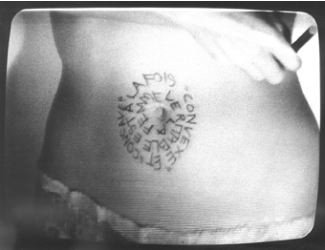 « Nil Yalter, artiste d’origine turque installée à Paris, a beaucoup travaillé sur la condition féminine. En 1974, elle a réalisé une oeuvre vidéo, La femme sans tête ou la danse du ventre, qui aborde la sexualité féminine avec franchise. La vidéo montre en gros plan le ventre de l’artiste ; avec un feutre noir, elle écrit autour de son nombril un passage du livre de René Nelly, qui s’intitule Érotique et civilisations : « La femme est à la fois «convexe» et «concave». Mais encore faut-il qu’on ne l’ait point privé mentalement ou physiquement, du centre principal de sa convexité : le clitoris […]. Cette haine du clitoris correspond en vérité à l’horreur ancestrale que l’homme a toujours éprouvé pour la composante virile et naturelle de la femme, celle qui, chez elle, conditionne l’orgasme absolu. «Une fois son ventre recouvert de texte, l’artiste commence à danser au rythme d’une musique traditionnelle. Son geste d’écrire sur son ventre a une signification particulière dans sa culture. En Anatolie, jusqu’aux temps récents, les femmes stériles ou désobéissantes étaient amenées à l’imam de leur village, et sur leur ventre, l’imam écrivait des phrases à caractère religieux. Le ventre devenait talisman. Dans sa vidéo, Nil Yalter retourne le sens de cette tradition en dénonçant la négation du plaisir des femmes. » Diana Quinby, De l’art et du féminisme en France dans les années 1970, Archives du féminisme, n° 8, décembre 2004
Dyketactics de Barbara Hammer
(Etats-Unis, 1974, 16mm, 4’)
(Etats-Unis, 1974, 16mm, 4’)
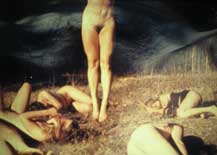 « En 1974, quand j’ai fait Dyketactics, la première histoire d’amour au cinéma par une lesbienne, je n’avais jamais vu de films, quel qu’il soit, réalisé par une lesbienne reconnue. Je commençais à m’intéresser à l’identité de l’artiste femme, de l’artiste lesbienne qui crée sans référence lesbienne en art. (…) Je me souviens que ce n’est pas la sexualité elle-même qui me poussa à faire le film. Ce fut plutôt la sensualité, l’expérience du toucher et de la sensation qui traduisaient au plus haut point, pour moi, l’amour d’une femme pour une autre femme. » Barbara Hammer
Personal Statement
Opus 19 du Cycle de l’Ange
de Maria Klonaris et Katerina Thomadaki
(1994, Béta SP, 8’)
Opus 19 du Cycle de l’Ange
de Maria Klonaris et Katerina Thomadaki
(1994, Béta SP, 8’)
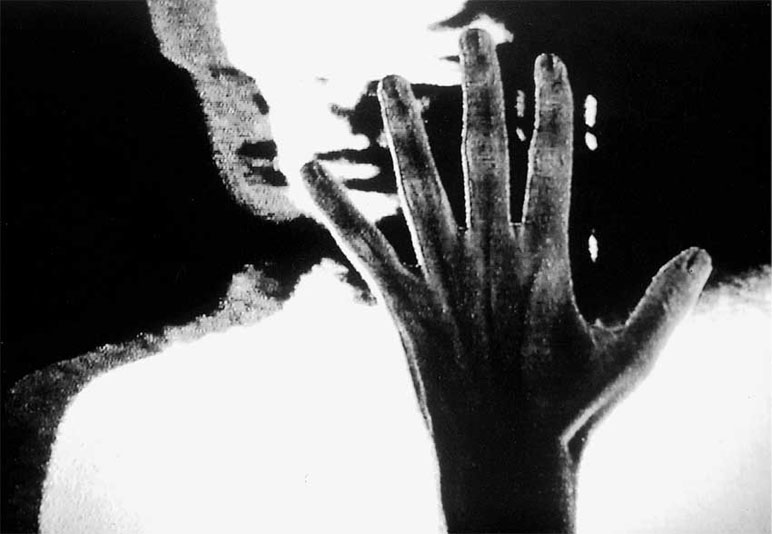 Personal Statement, le 19e volet du Cycle de l’Ange, met en scène des traitements photographiques d’un document médical d’hermaphrodite, provenant des archives du Dr. G. Klonaris. Le sexe du sujet photographié dépasse la dichotomie masculin / féminin devenant une métaphore puissante de l’effondrement des limites des sexes. Les images se déploient verticalement pendant que des mains féminines (Katerina Thomadaki) tentent de caresser ce corps mutant. La voix off (Maria Klonaris) s’adresse au sujet photographié: Image magique. Une hermaphrodite. C’est toi. C’est ton corps. Les yeux bandés. Tu es devenue une infinie fiction amoureuse. Hermaphrodite. Ange. Corps mutant. Tu brises les frontières. Identité mosaïque. C’est ton corps. C’est mon corps.
Identité “mosaïque” se réfère au terme médical de “mosaicisme” qui désigne en génétique les combinatoires de chromosomes de sexe mixte ou hermaphrodite. Cette vidéo fait partie de la réflexion imagée que nous menons depuis 1982 sur l’hermaphrodite, l’androgyne et l’ange. M.K. – K.T., 1994
Site: www.klonaris-thomadaki.net
Action de corps exclus
de Michel Journiac et Gérard Cairaschi
(1983, 15′, Dv cam)
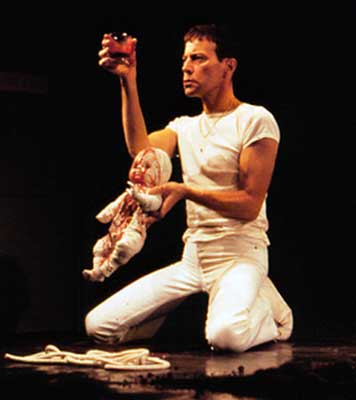 "Le corps est le lieu de tous les marquages, de toutes les blessures, de toutes les traces.
Dans les chairs s’inscrivent les tortures, les interdits des classes sociales, les violences des pouvoirs, dispersés mais jamais abolis. Aujourd’hui, seuls les exclus créent. Car c’est leur corps qui parle, énonce le refus. Le cri NO FUTURE – si ce futur est le présent continué – est cri d’espoir. Du «tiers exclu» au «tiers monde» surgit le désir du corps communication et nécessite une nouvelle forme de création. Un corps sujet du mot est mort, un corps lié à l’ordre du désordre, au Dieu de la morale du travail, de la famille et de la patrie. ici et maintenant, la parole du corps est corps. Son insurrection de viande-consciente vers le sacré, vers l’autre, naît peut-être simplement de la fulgurance ontologique de la caresse." M.J.
Halloween Queen 1
de Sothean Nhieim
(France, 20’, super 8mm)
Dans une ambiance vénéneuse teintée d’une touche fantastique, Halloween Queen 1 est un hommage queer au Fantômas et aux vampires de Louis Feuillade. Une créature sublime et ambiguë, comme surgie d’un fantasme, se meut dans le halo ténébreux de la nuit.
KQ&AI
Les films de Sothean Nhieim s’interrogent sur « les mutation identitaires et la force de contestation des identités sexuelles marginales »
«Les films de Sothean Nhieim font traverser aux visages et aux corps qui passent devant la caméra tous les états figuratifs, de l’ébauche à l’allégorie…la lumière du monde et du cinéma fait passer dans le réel tout ce qui pourrait relever d’une quelconque métaphysique: immanence absolue qui sublime les puissances optiques du monde». Xavier Baert in «Jeune,dure et pure»
21h45
Des imaginaires Queer
Des imaginaires Queer
Séance en présence du GAT, de Nexus et de Raphaël Vincent.
I’m still here: Becoming Legendary
de Gina Lamb
(Etats-Unis, 35’)
Inédit en France
de Gina Lamb
(Etats-Unis, 35’)
Inédit en France
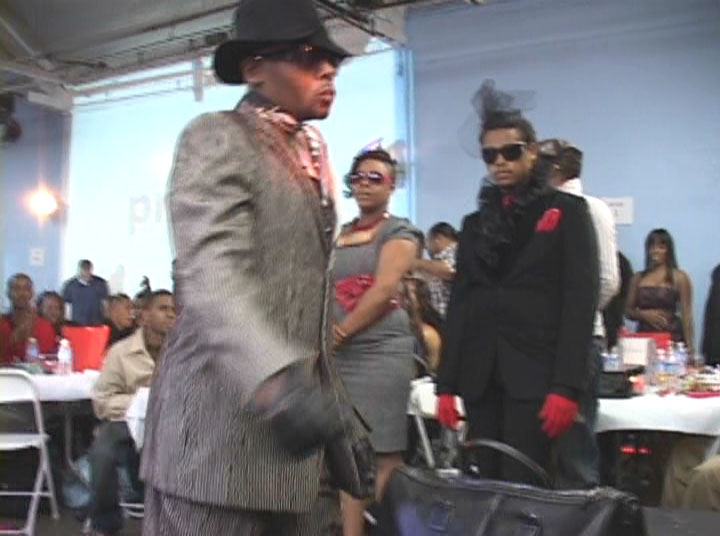 La créativité, l’humour, et la luxuriance des performances de soi dans les ballrooms de Los Angeles, où les communautés black et hispanics se réinventent au travers de défilés de mode extravagants. Cette subculture a été popularisée par le film Paris is burning de Jennie Livingstone. Ici, on retrouve des entretiens avec les légendaires pionniers et actuels protagonistes d’une pratique qui a une longue histoire, connue sous le nom voguing, remontant aux années 30 à Harlem, où vêtus de leurs plus beaux vêtements, les descendants des esclaves noirs américains paradaient en ligne comme les nantis blancs de Park Avenue. On raconte que cette tradition s’ancre plus lointainement encore auprès des esclaves eux-mêmes qui, pour garder leur fierté, se réunissaient entre eux revêtus de leurs plus beaux habits afin de réaffirmer leur dignité. Depuis les années 70, le but du "Voguing" est de reprendre les poses des modèles blancs des magazines de mode, comme Vogue, et montrer qu’on peut être pauvres, noirs et exclus mais être chics et fiers. Le mouvement a peu à peu été repris par la communauté gay, drag queen, trans d’ Harlem et des «maisons» se sont créées. Il s’agissait de ‘gangs» portant les noms de Saint Laurent, House of Revlon ou House of Xtravaganza qui s’affrontaient dans des battles de «voguing» avec jury.
KQ&AI
Marcus Fisher’s wake
d’Oreet Ashery
(Royaume-Uni, 2002, DV, 18’)
d’Oreet Ashery
(Royaume-Uni, 2002, DV, 18’)
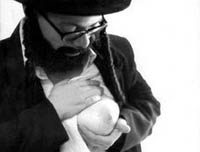 Dans la vidéo Marcus Fisher’s Wake, Oreet Ashery utilise une voix off dite par le photographe queer Del LaGrace Volcano pour élaborer un document-performance sur son alter ego juif orthodoxe, Marcus Fischer. L’œuvre suit son «voyage vers la découverte de soi», montrant son retour dans les quartiers hassidiques de Jérusalem où il prend garde à ne pas se faire démasquer, puis ses expéditions aventureuses dans les clubs gays de Londres et les cafés turcs exclusivement masculins de Berlin. Oreet Ashery travaille à Londres. Artiste pluridisciplinaire, elle souhaite favoriser un dialogue entre art «en direct» (interventions, performance, interaction), œuvres numériques (vidéo, photographie, son) et texte.
Oreet s’intéresse au glissement entre art et vie, aux nouvelles mutations des formes artistiques contemporaines, et à l’angoisse culturelle liée à la culture populaire. Ses œuvres prennent souvent la forme d’événements in situ, le public en devenant partie prenante. Elles se concentrent sur la politique du corps et les variations introduites par la culture et l’environnement.
Only one box de Nexus
(France, 2006, DVD, 8’)
(France, 2006, DVD, 8’)
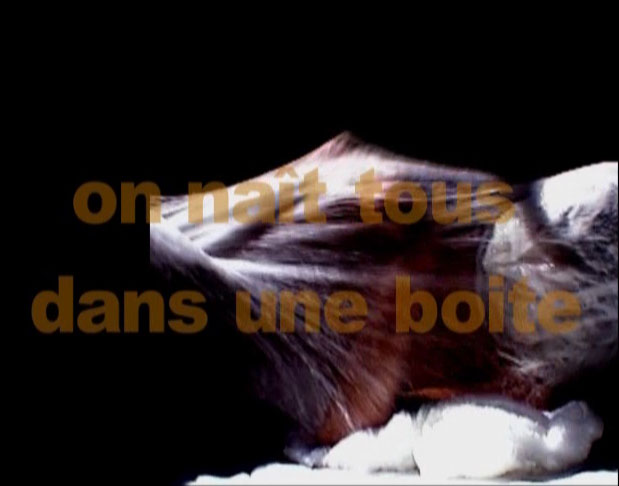 « Quand j’ai demandé à Del LaGrace Volcano pourquoi elle avait photographé mes amis Drag Kings dans une boite, elle m’a répondu “on est tous dans une boite”. Un poncif philosophico-queer semblerait-il. La petite phrase fit son chemin. Si il est vrai qu’on nait tous dans une boite…ce n’est qu’une boite. Mon corps n’est ni prison ni refuge, juste l’emballage coquet de ma dualité. Only One Box est une histoire d’accouchage, mon accouchage. » Nexus
Ruins
de Raphael Vincent & Ruins Production
(France, 2004-2006, 23’)
de Raphael Vincent & Ruins Production
(France, 2004-2006, 23’)
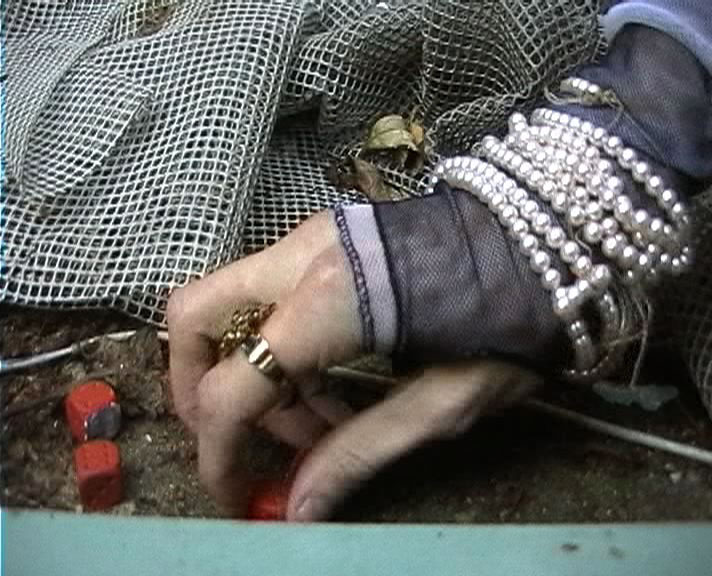 « Tous les écrans avaient été détruits. Je me souviens que l’on cherchait les images partout. Je crois que nous errions. Il y avait de la poussière et des débris. Je pense que se souvenir était au centre de la question. Les bandes s’étaient évanouies, les écrans avaient implosé. On pouvait sentir ette étrange fumée, paque, celle qui reste longtemps collée au nez, aux yeux. Comme de la neige. Ou de la brume. Les téléviseurs n’étaient plus alimentés. Les murs n’étaient plus réellement des murs. Les espaces communs étaient défaits. »
Ruins est la trace d’un long voyage à travers l’Europe de l’Ouest dans différentes communautés queer autonomes. Les rencontres et les lieux ont été l’occasion de réaliser les cinq parties qui constituent ce projet artistique. Ni fiction ni documentaire, Ruins fouille les systèmes de production d’image pour mettre à jour des identités qui échappent à l’œil du système. « C’est à l’intérieur des ruines que se trouvent nos objets, fragments de genre, pièces éparses de nos histoires, des bouts de sexe, des images floues. Il fallait inventer des scènes, des attitudes et des performances. Nous réapproprier. Les maisons comme des squelettes autour de nous, les déchets et le reste. Le béton comme ami. Les bouts de verres étincellent. »
Le doigt de Dieu ou la bite à Lacan
du Groupe Activiste Trans’
(France, 15’)
du Groupe Activiste Trans’
(France, 15’)
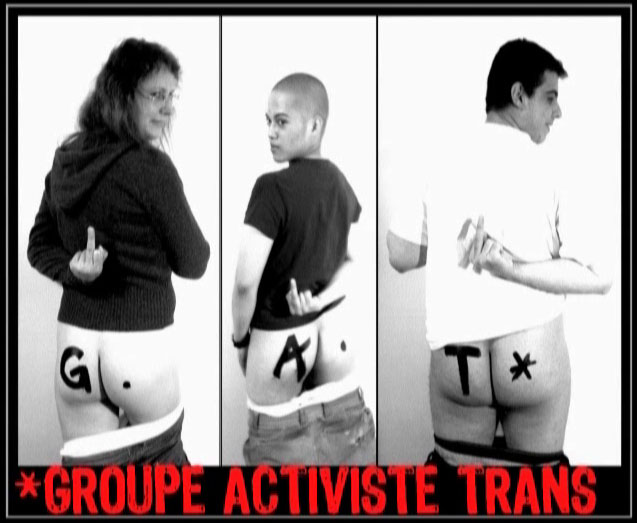 « Un jour, le syndrome « Contre Trans Lacanien Pré-Féministe Hétéro Fétichiste » a pu être clairement identifié. Et c’étaient des psys lacaniens essentiellement qui en étaient porteurs, et vecteurs. La première à identifier le CTLPHF fut Marie-Hélène Bourcier. En 2003. Elle avait un jour détaillé, devant une assemblée de psys ébahis, les deux dénis principaux sur lequel repose le syndrome de CTLPHF :
1- La forclusion du nom de Lacan
2- Le déni de leur militance hétérocentrique pour faire valoir leur délire de la différence sexuelle comme nature.
Très vite, il a fallu se rendre à l’évidence, les psys souffraient, et profondement, de la confusion terrible que leur grand chef Lacan avait faite entre le phallus et sa bite. Brutalement, il leur devenait insupportable d’imaginer Lacan sans sa bite »
Pansexual Public Porn
aka The Adventures of Hans & Del de Del LaGrace Volcano
(1997, DV, 11’)
aka The Adventures of Hans & Del de Del LaGrace Volcano
(1997, DV, 11’)
Del LaGrace Volcano et son ami transgenre, Hans, [réalisateur de Dandy Dust] se baladent dans un lieu de drague gay. Leur rencontre avec les passants du lieu échappe aux stéréotypes et à la normativité attendue.