Mardi 20 Mars
18h
Freaks
In Advance of a Broken Arm
de Lee Adams
(1995, vidéo, 3’)
Inédit en France
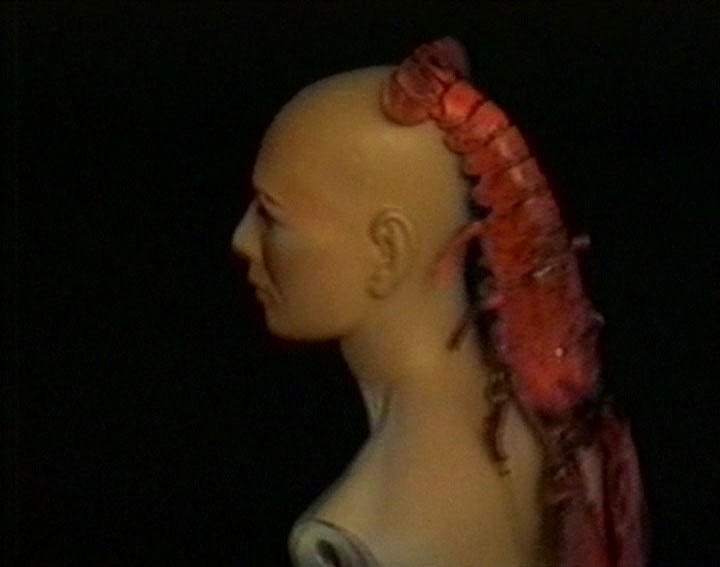 Tirant son titre d’un ready-made de Marcel Duchamp, In Advance of a Broken Arm a été créé comme un hommage aux cineastes expérimentaux pionniers du surréalisme. Lee Adams est l’initiateur du festival Sex mutants. « A travers une série de mélancoliques et souvent viscérales performances, allant de l’intime jusqu’à l’épique, j’ai tenté d’examiner la position et la relation entre le performer et le public, questionnant les notions de vraies / et fictionnelles performances du moi, l’altérité, la différence, le genre, le sexe, l’amour, la douleur et la souffrance, la transcendance et les politiques du corps en relation à la culture et au pouvoir. » L.A
(distribution: le peuple qui manque)
Freak Orlando
de Ulrike Ottinger
(Allemagne, 1981, vidéo, 126’)
de Ulrike Ottinger
(Allemagne, 1981, vidéo, 126’)
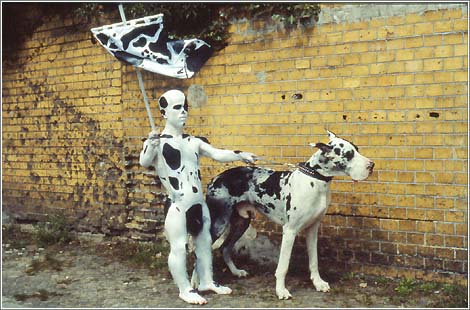 Le modèle de ce superfreak, le freak du titre, c’est Orlando, du roman de Virginia Woolf, qui accomplit le rêve ancestral de l’homme androgyne ; et comme l’Orlando du roman, il n’est pas non plus soumis au passage du temps, ce qui suffit à le transformer en monstre d’expériences… Les grands magasins de Freak orlando sont le temple des promesses, le point de rencontre des fidèles, dans lequel la vie publique se règle selon des liturgies déterminées où se fixent les normes. Frieda Grafe, Süddeutsche Zeitung, 7./8.11.1981.
Les films de Ottinger que certains historiens du cinéma incluent dans la catégorie du cinéma queer proposent une renégociation de la subjectivité et dépassent les débats habituels autour de genre et de la sexualité de la théorie féministe traditionnelle. Comme beaucoup de films Queer, son travail accorde aussi leur importance au plaisir visuel, à l’excès, au fantasme et laisse que le spectateur jouisse de toutes les possibilités de la narration. Cependant, malgré l’illusion de continuité et/ou d’unité que nous expérimentons en voyant ses films, Ottinger crée des tableaux vivants et sagas à épisodes qui vont plus loin que les possibilités de la performance et de la représentation du genre. Ses films sont un hybride entre science fiction, films d’aventure, documentaire et fantasmes qui s’entretissent en narrations non linéaires. Dans l’œuvre d’Ottinger, la réalité est seulement une aura. Chaque image est une surprise et les films fonctionnent comme sous-textes de différents thèmes, depuis les préjugés sociaux jusqu’à l’ostracisme, à partir des rituels de pouvoir et de mort. Sa réappropriation d’une esthétique du narcissisme depuis un discours féministe rend son œuvre très inusuelle (…). Freak Orlando, inclut une cour ample de personnages étranges et fonctionne quasiment comme un road-movie a-historique. Il s’agit de compositions théâtrales où parfois on joue avec des vieilles formes revêtues élégamment avec des matériaux de dernière génération. Descriptions verbales, souvenirs visuels, et une forte sensibilité picturale et cinesthésique s’unissent pour construire des tableaux de paysage, habitations, ambiances, et scènes. (Explorafoto 2006, trad. K.Q.)
20h
Judith Cahen & Alberto Sorbelli
En leur présence
Judith Cahen & Alberto Sorbelli
En leur présence
La révolution sexuelle n’a pas eu lieu de Judith Cahen
(France, 1998, 35 mm, 120’)
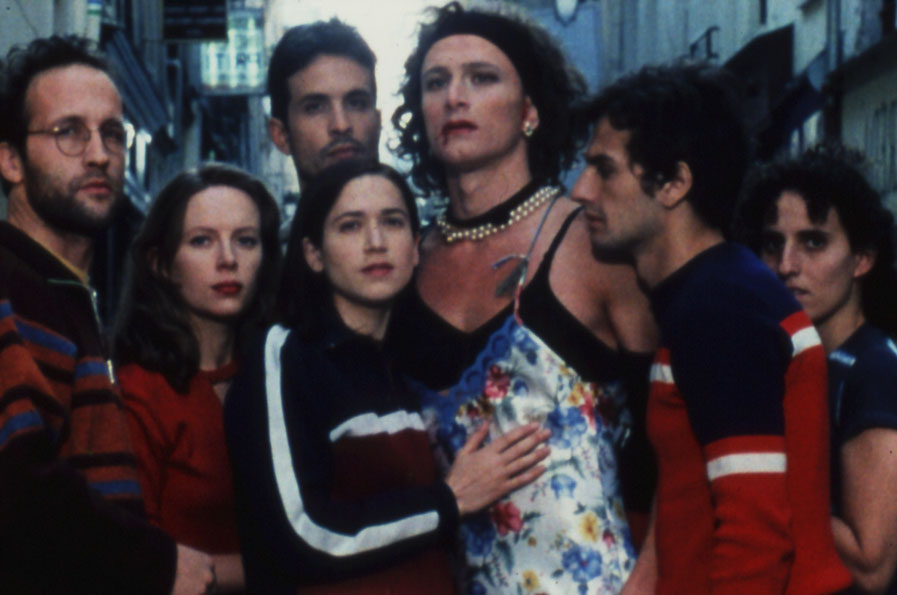 D’une résistance boudeuse et angoissée à l’idéal féminin en passant par une interrogation trouble sur la vérité du genre et la possibilité de son apprentissage (Anne Buridan – alter ego de la réalisatrice – tentant d’apprendre ce que c’est qu « ’être une femme » auprès d’un « homme-femme » alias Alberto Sorbelli) à un questionnement sur la nature du désir, ou le dilemme entre corps glorieux et organiques, l’autonomie et la propriété du corps, les motifs Queer qui habitent le cinéma de Judith Cahen sont légions et peuplent cette interrogation brillante sur la fabrique du collectif, et sur ce que serait une révolution sexuelle.
K.Q. & A.I.
Entretien avec Catherine Millet autour d’Alberto Sorbelli
par Judith Cahen
(2007, vidéo, 15’)
Inédit
par Judith Cahen
(2007, vidéo, 15’)
Inédit
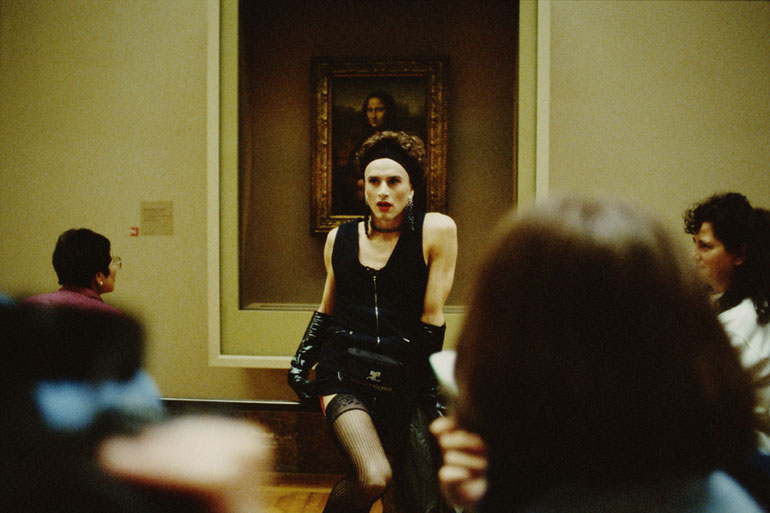 Alberto Sorbelli, artiste performer, a œuvré jusqu’à aujourd’hui dans le champ des arts plastiques (musées, galeries) avec des propositions qui mettaient en évidence la relation entre le spectateur et l’œuvre. Connu dès le début des années 90 par des performances, mettant en scène trois personnages : le secrétaire, la prostituée et l’agressé. En 1994 au MAM de la Ville de Paris, son Club hiver de l’amour est censuré en raison d’un « soupçon de prostitution réelle » de l’artiste. Catherine Millet revient dans cet entretien sur l’exclusion d’Alberto Sorbelli.
La thématique du « corps travesti » me permet d’évoquer le travestissement dans le sens où je le pratique : j’essaie de comprendre en quoi « me travestir », c’est « devenir ». Ce qui nous perturbe dans l’idée du travestissement, c’est que la société préfère ce qui est distinguable dans un genre, elle en reste à l’interprétation d’un rôle sans travailler sur l’identité. (…) Certains ont pensé que je dénonçais le système marchand du milieu de l’art en lui montrant son reflet. Ce qui les gênait le plus, c’était de se sentir dénoncés par une image qu’ils refusaient, celle d’une grosse pute vulgaire. Alors que moi, j’étais une pute sublime ! Je n’étais pas dans la démonstration mais dans l’affirmation de ma liberté, célébrant cet individu qui n’est ni une figure indigne ni un objet de mépris. Dans toute mon œuvre, je ne dénonce pas, je ne critique pas, je célèbre. Dans ma hiérarchie sociale, la prostituée est indiscutablement au sommet de la pyramide. (…) Alberto Sorbelli, entretien de Chantal Hurault à paraître dans *Alternatives Théâtrales, n° 92, mars 2007.
22h30
Manifeste pour un cinéma de la transgression
|
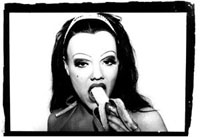 « Toutes les valeurs doivent être changées. Rien n’est sacré. Tout doit être questionné et réexaminé afin de libérer nos esprits de la foi en la tradition. La croissance intellectuelle demande que l’on prenne des risques et que des changements surviennent dans les agencements politiques, sexuels et esthétiques, peu importe qui désapprouve. Nous proposons d’aller au-delà de toutes les limites données et prescrites par le goût, la moralité et tout autre traditionnel système de valeur qui enchaînent les esprits des hommes. Nous passons et allons au-delà des limites des écrans et des projecteurs pour aller vers un état d’ « expanded cinéma ».
Le « cinéma de la transgression », dont le manifeste fut écrit par le réalisateur Nick Zedd et dont les parangons dans le New York Underground des années 80 furent également Richard Kern ou Lydia Lunch, voulait concilier «Andy Warhol, le mouvement dada et la punk attitude», et trouva, dans ses travestissements, mutilations, rituels S/M, des filiations avec les cinémas Queer de Jack Smith, John Waters, Bruce LaBruce, ou encore avec des Actionnistes viennois, et rencontra surtout dans le performer, musicien et écrivain Jean-Louis Costes un émule français. Le cinéma Queer appartient-il davantage au registre de la transgression ou de la production de subjectivités et sexualités alternatives ? Ce programme propose quelques pistes de réflexion au croisement de ces cinémas.
Séance présentée par Jean-Claude Moineau
(théoricien de l’art, professeur à l’université Paris VIII, autour de « Art et identité »)
(théoricien de l’art, professeur à l’université Paris VIII, autour de « Art et identité »)
6/64 Mama und Papa
de Kurt Kren
(1964, 3’57, 16mm)
Perf: Otto Mühl
de Kurt Kren
(1964, 3’57, 16mm)
Perf: Otto Mühl
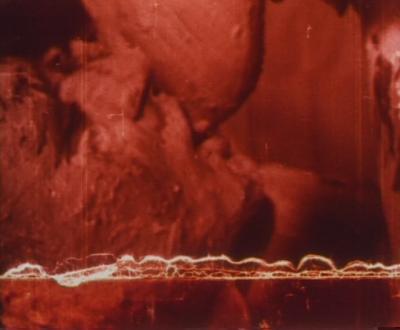 Première collaboration de Kren avec l’Action Group, il tourne 82 plans dont l’axe de vision est les organes génitaux du modèle et monte le tout selon un plan préétabli. Les performances empreintes de sexe et de violence réalisées au début des années 1960 par Otto Mühl (inaugurant le passage de l’Action Painting à la performance directe avec ses Materialaktionen), Günter Brus, Rudolf Schwarzkogler et Hermann Nitsch (fondateur du Théâtre des Orgies et des Mystères), mêlant flots de peinture, dépouilles d’animaux, performers nus, scarifications, excréments et autres sécrétions corporelles ont gardé leur aura de scandale et leur parfum d’interdit, jusqu’à en être presque invisibles. Décomposant les gestes les plus symboliques et les rapportant les uns aux autres par un montage alterné très rapide, Kren [cinéaste expérimental autrichien qui filma en 16mm plusieurs actions de Günter Brus et d’Otto Mühl sur leur demande] restitue la frénésie du rituel. Benjamin Thorel, Annexia
Kugelkopf de Mara Mattuschka
(1985, 16 mm, 6’)
(1985, 16 mm, 6’)
 Mara Mattushka, cinéaste fixée à Vienne d’origine bulgare, pratique un cinéma de monstres, peuplé d’échos avec l’actionnisme. La violence cathartique de son travail, dont la dimension politique est, ici, liée, de manière palpable, à l’aliénation du travail, est prise en charge par Mattushka, sous les traits de son alter ego androgyne, Mimi Minus. KQ
Convulsion Expulsion
de Usama Alshaibi
(Etats-Unis, 2004, 6’)
de Usama Alshaibi
(Etats-Unis, 2004, 6’)
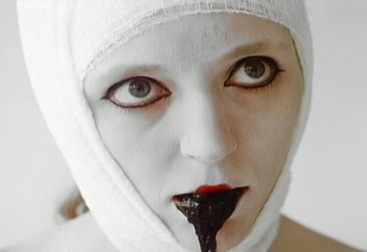 Sang de la honte ? de l’oppression ? de la jouissance ? Dans ce film inquiétant et énigmatique, dans la veine d’une pornographie surréaliste, une créature, au teint de porcelaine et enveloppée dans une gaze, vacille et projette du sang hors de son anus.
Usama Alshaibi est un plasticien basé à Chicago, d’origine irakienne, auteur notamment du long-métrage Muhammad et Jane et est le fondateur du Z Festival à Chicago
KQ & AI
Day’s Night
de Catherine Corringer
(France, 2005, Béta SP, 20’)
de Catherine Corringer
(France, 2005, Béta SP, 20’)
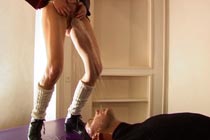 Day’s Night est ce qu’on pourrait appeler un « film performance ».
Ancré dans un univers sado-masochiste particulier, n’ayant recours à aucun des instruments couramment utilisés dans ces pratiques, il explore quelques fantasmes enfantins et archaïques tels que l’interrogation sur la sexuation, le corps, le jeu avec la nourriture, l’urologie ou encore le mythe de la dévoration. (Catherine Corringer)
Holy Virgin Cult de Jean Louis Costes
(2003, vidéo, 38’)
(2003, vidéo, 38’)
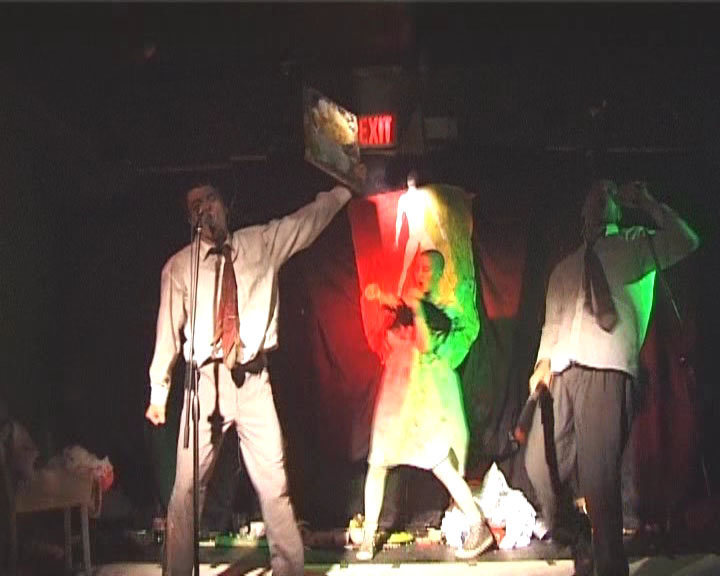 Dans sa démesure, Holy Virgin Cult, opéra-porno-social, défait et désigne, d’une manière bouleversante et comme anthropologique, les limites de l’humain.
« La scène est un lieu de transgression symbolique – et si on utilise cet espace simplement pour bouffer des yaourts, c’est pas la peine. On n’a pas besoin d’un lieu symbolique pour faire des choses autorisées. On a besoin d’un lieu symbolique surtout pour représenter le crime, afin que la catharsis opère. » L’art irrécupérable (Jean Louis Costes, interview de Matthieu Blestel et David Sanson pour Mouvement – 2005)
Art et institution, lieu de l’art et scène symbolique comme possibles de la transgression sont également des questions ouvertes pour ce programme.
KQ & AI