Samedi 17 Mars
Queer & Post-colonialisme
Pour cette 2nde édition du Festival, et en écho à une situation politique française qui l’appelle urgemment (révoltes des banlieues, politiques d’immigration, mondialisation, etc.), nous affermirons notre volonté de donner davantage de place encore à la lecture, l’analyse, l’invention de croisements des luttes politiques Queer avec d’autres champs d’action politique et opérerons cette année un rapprochement conscient avec le champ post-colonial et un regard plus précis sur diverses situations de colonialité, afin, aussi de prendre la mesure de solutions inventées par certains artistes et collectifs ici et là, qui tentent de mettre en place leurs résistances. Le rapprochement entre questions de genre et études post-coloniales est depuis longtemps déjà appelé de ses voeux par la critique Queer, et le champ post-colonial aux Etats-Unis notamment avec des théoriciennes comme Gloria Anzaldua, bell hooks, Chela Sandoval, Angela Davis, Gayatri Spivak. Ces questionnements qui agitent, au jour où nous parlons, les universitaires, activistes, théoriciens du Queer en France, se sont traduits également par des tentatives de rapprochement entre groupes d’activistes Queer et collectifs mobilisés par une critique du post-colonialisme en France. Au travers de quelques films fictionnels (J.-P. Bekolo, Stuart Gaffney), militant (Mujeres Creando), plastiques (Steven Cohen) et documentaires, nous avons souhaité voir ce que ce cinéma pouvait nous donner à réfléchir. Nous espérons y trouver l’esquisse urgente d’une possible alliance des luttes ici et maintenant.
15h50
Quartier Mozart de Jean-Pierre Bekolo
(France, Cameroun, 1992, 35 mm, 79’)
(France, Cameroun, 1992, 35 mm, 79’)
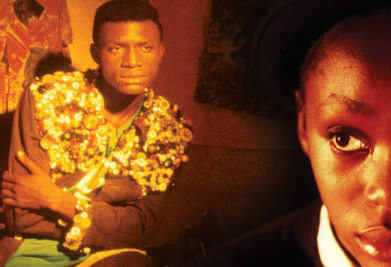 S’il est avant tout une chronique urbaine des quartiers africains, ce film solaire et plein de grâce aborde en filigrane le motif du changement de sexe, rarement aperçu dans le cinéma de fiction africain. La sorcellerie étant ce qui permet d’y donner lieu, le film baroque et bigarré de Jean Pierre Bekolo, narre avec truculence les aventures d’une fillette habitant le quartier Mozart. Transformée par la sorcière Mama Thecla en jeune homme et désormais prénommé ‘Montype’, l’héroïne rejoint la bande de jeunes du quartier Mozart qui passent leur temps à draguer; ceux-ci la poussent à séduire Samedi, la fille de Chien méchant, le gros policier du quartier.
KQ/AI
En présence de Jean-Pierre Bekolo
Des hommes et des dieux
de Anne Lescot et Laurence Magloire
(Haïti, 2002, DV, 52’)
de Anne Lescot et Laurence Magloire
(Haïti, 2002, DV, 52’)
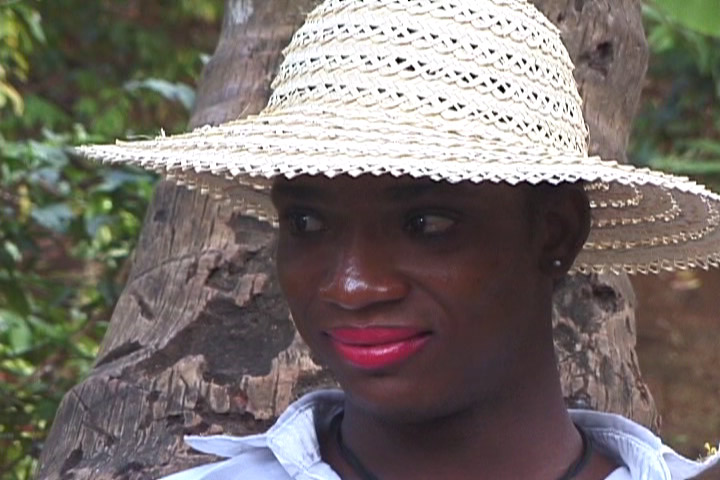 Ce documentaire a été tourné auprès des masisis (« folles ou travestis », en créole) d’Haïti, dans un contexte donné: le vodou. La mise en relation de ces deux mondes nous conduit dans un univers symbolique particulier, où les non-dits de la société civile donnent à s’exprimer, parfois dans la plus grande extraversion et théâtralité, parfois avec une émotion profonde. Une émotion reflétant la quête de sens et de reconnaissance d’individus marginalisés dans un pays où l’évocation de l’homosexualité, et qui plus est du travestissement, reste encore tabou. Le vodou devient alors un espace libérateur inattendu, d’expression ou chacun, quelque soit son identité peut trouver protection et réconfort, nous entraînant peu à peu dans un monde spirituel complexe et fascinant. Ce film est le premier du genre à lier ces deux sujets sensibles et résolument actuels.
En présence de Anne Lescot
18h30
Projection-débat : Politiques Queer & post-colonialisme
Black Nations / Queer Nations de Shari Frilot
(Etats-Unis, 1995, Béta SP, 59’)
(Etats-Unis, 1995, Béta SP, 59’)
 Black Nations / Queer Nations est un rare et remarquable documentaire expérimental issu d’une conférence qui eut lieu durant trois jours en mars 1995 à New York. Y défilèrent de nombreux travailleurEs, activistes, artistes, universitaires de la diaspora africaine LGBT dont Coco Fusco, Essex Hemphill, Kobena Mercer, Barbara Smith, Urvashi Vaid, Isaac Julian ou Jacqui Alexander qui interrogèrent les situations économiques, sociales et politiques de cette diaspora LGBT et de ses luttes d’empowerment. Les participantEs discutèrent de plusieurs thématiques : les migrations, les identités black et queer, le black feminism, les imperfections du nationalisme noir, l’homophobie dans les communautés noires, les cultures, arts et imageries black queer, etc.
La vidéo condense les moments les plus déterminants de cette conférence, et dessine des connections entre la culture populaire et les productions de « média » gay et black contemporaines, notamment à partir d’extraits de films d’Isaac Julian et Bodily Functions de Jocelyn Taylor, tout en invitant le spectateur à considérer l’existence d’une identité black queer et la possibilité de la définir ou la représenter. (TWN, tr. KQ)
Débat en présence de Louis-Georges Tin (porte parole du CRAN – Conseil représentatif des Associations Noires, enseignant à l’université d’Orléans, auteur du Dictionnaire de l’homophobie), Eric Fassin (Sociologue, enseigne à l’ENS, auteur de L’inversion de la question homosexuelle et co-dir. De la question sociale à la question raciale ?), Elsa Dorlin (philosophe, enseignante à Paris 1, auteure de La Matrice de la race, généalogie sexuelle et coloniale de la nation française), et le collectif Les Panthères Roses
20h30
Artistes, Genres &
Post-colonialisme
Chandelier de Steven Cohen
(Afrique du Sud, 2002, Béta Sp, 17’)
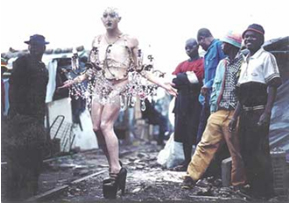 La vidéo de Chandelier a été réalisée au milieu des SDF noirs de Johannesburg pendant la destruction de leur bidonville par les employés municipaux de la ville (habillés en rouge) dans un ballet où la violence est omniprésente. « Les artistes ont toujours dépeint la vie sociale de leur époque, par mes déplacements en chandelier-tutu à travers le bidonville en état de destruction et par le fait de filmer, c’est ce que je fais aussi : une peinture digitale de la vie sociale, à moitié imaginaire, et à moitié horriblement vraie ». Le travail de Chandelier révèle à travers l’art de la performance, de la danse et du film, les contradictions entre l’Europe et l’Afrique, les blancs et les noirs, les riches et les pauvres, l’ombre et la lumière, le privé et le public, les forts et les opprimés, la sécurité et le danger». (texte extrait du programme des Ballet Atlantiques, pour la présentation du spectacle not so good, Steven Cohen).
Transgressions de Stuart Gaffney
(Etats-Unis, 2002, Béta Sp, 6’)
Inédit en France
(Etats-Unis, 2002, Béta Sp, 6’)
Inédit en France
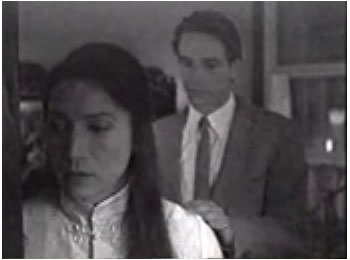 Objet poétique, qui tient à la fois d’une réflexion sur le cinéma, comme espace du désir et de la reconnaissance de soi, sur les origines, l’identité, la répétition des schémas amoureux, Transgressions, pense le multiculturalisme, la rencontre des « races », en tant que lignées, la rencontre des sexes, et la possibilité de création de nouvelles espèces sexuelles et raciales « queer ».
KQ/AI (distribution: le peuple qui manque)
Mama no me lo dijo
de Maria Galindo & Mujeres creando
(Bolivie, 2003, DVD, 52’)
de Maria Galindo & Mujeres creando
(Bolivie, 2003, DVD, 52’)
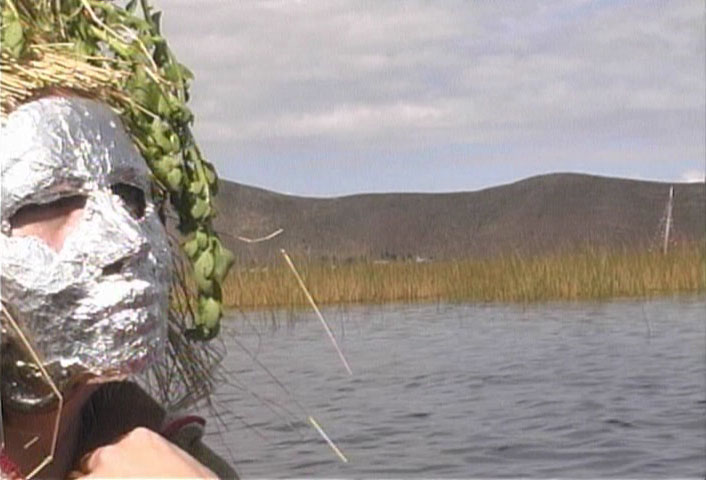 Le groupe radical féministe bolivien, Mujeres Creando, constitue un exemple rêvé de dispositif d’actions transversales. Agissant de façon nomade et décentralisée (en graffitant les murs de la capitale bolivienne de toniques interpellations poétiques et politiques à l’égard du système patriarcal ou du racisme et de la pigmentocratie), elles se font l’écho de la situation des femmes latino-américaines, prises dans les rets d’un système machiste mais accueillent aussi au sein du groupe, toutes les multiplicités (lesbiennes, hétérosexuelles, femmes indigènes, paysannes, prostituées, athées, croyantes, etc.). KQ/AI
22h
Black Feminism
Black Feminism
Out – Naissance d’une révolutionnaire
de Rhonda Collins et Sonja de Vries
(Etats-Unis, 2000, 60’)
de Rhonda Collins et Sonja de Vries
(Etats-Unis, 2000, 60’)
 Condamnée en 1983 pour avoir posé une bombe au Capitole et pour avoir « conspiré pour influencer et changer la politique américaine », Laura Whitehorn a passé 14 ans en prison. Lesbienne déclarée, elle a été de tous les mouvements civiques américains, des Black Panthers au féminisme… et témoigne sur son passage à l’action violente et sur les centaines de prisonniers politiques toujours emprisonnés aux Etats-Unis. Très loin d’un documentaire classique, Out est un portrait passionnant d’une femme détonante et une incitation à l’action. (Pinkscreen)
The Edge of Each Other’s Battle – Audre Lorde
de Jennifer Abod
(Etats-Unis, 2002, DVD, 59’)
de Jennifer Abod
(Etats-Unis, 2002, DVD, 59’)
 Audre Lorde, tant par sa personnalité que par ses écrits, a été une des figures marquantes du féminisme aux Etats-Unis. Elle a uniformément défié le racisme, le sexisme, le classicisme et l’homophobie. Jennifer Abod nous traduit cette vision à travers un colloque organisé en son honneur deux ans avant sa mort du cancer en 1992. Ce documentaire est une flamboyante exhortation à l’activisme perpétuel et joyeux. (Pinkscreen)